
Download this path as a PDF file
Download the Map as a PDF file

Download combined Map and Path to print as a booklet
Hertfordshire Pilgrim Ways
The Little Wymondley, Great Wymondley & St Ippolyts Loop
Introduction
God created the world and everywhere is holy. Although God can be encountered anywhere, sometimes it takes a slow, walking pace around places associated with holiness to open our eyes and make us aware of God’s presence.
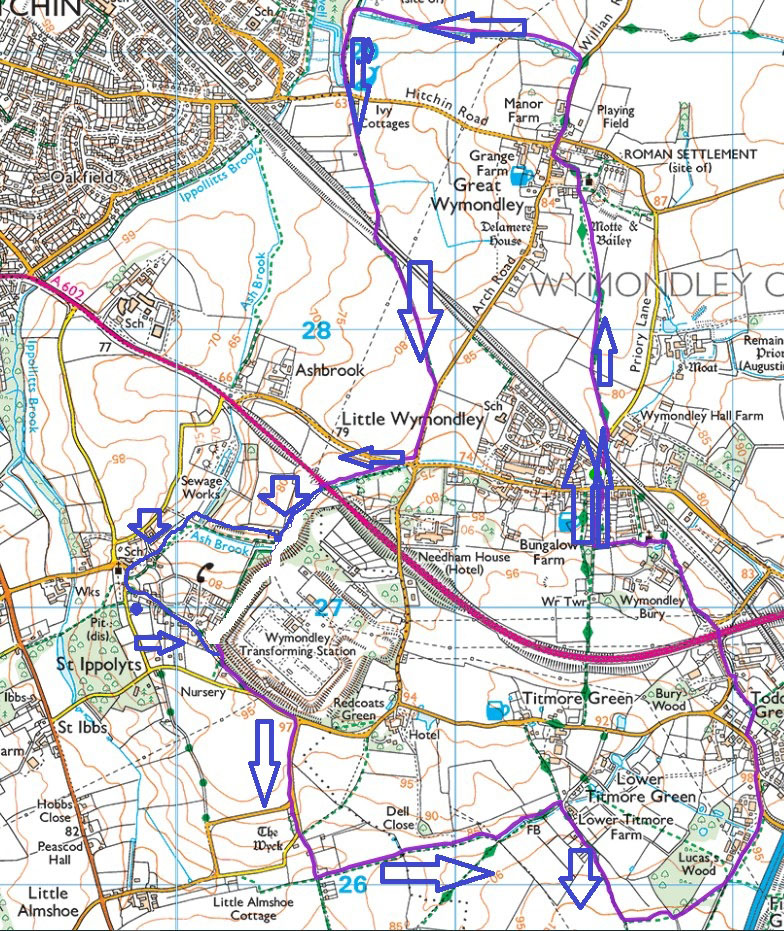
This seven mile circular walk will take you through Roman and medieval sites. Each stop includes a brief history of the place, a Bible verse and a short reflection. It is designed to help connect us with the sacredness of our local landscape, buildings and local history.
The aim is not just to be a pleasant physical ramble though the countryside between places of interest, but a mini-pilgrimage, food for a spiritual journey. As you walk, be aware of all your senses. Listen to the sounds around you, look at the shape of the land, light and shadows. Notice what draws your attention. May be you will stumble across God in the unexpected.
Revd. Bill Britt, Vicar of Stotfold & Radwell
Directions to starting point:
The walk begins at Little Wymondley (SG4 7JE)
If you are traveling via the A1(M), leave Junction 8, taking the exit signposted Little Wymondley. Immediately after you pass under the railway bridge, take the first left along the railway line. (Do not take Church Road). Drive along the lane and find a place to park. Continue to walk until the road ends at the gates of Wymondley Bury. Enter churchyards through side gate into the churchyard and enter St Mary the Virgin, Little Wymondley.
St Mary the Virgin, Little Wymondley
Bible Verse
Psalm 24 Verse 4
One thing I asked of the Lord,
that will I seek after:
to live in the house of the Lord
all the days of my life,
to behold the beauty of the Lord,
and to inquire in his temple.
Background
The chancel and nave of the church date back to the 12th Century
Reflection
Just inside the chancel is a clear window, etched with a dove, a symbol of the Holy Spirit, flying below a cross. The words “Glory to him who evermore by truth and justice reigns,” are from the poem “The Dream of Gerontius” by Cardinal John Henry Newman, which was set to music by Edward Elgar. The poem is a conversation between a dying man and his guardian angel, who reassures him that God’s love will remove his sins.
The window is in memory of the Rev David Tanqueray, who once sat in the vicar’s stall by this window. During services he would have gazed out through an earlier window and seen the spot a few feet away in the churchyard where he would be buried in 1971, age 44. He lived and continues to live in the house of his Lord.
Directions to the site of the Wymondley Priory
As you leave the church walk straight ahead to the iron kissing gate and turn right along Public Footpath 10.
At the end of the footpath, turn right onto Tower Close. Cross over Stevenage Road at the crossing in front of the Plume of Feathers. Walk along the right side of the pub onto Priory Lane. Before crossing under the railway line, cross over to the pavement under the bridge.
Immediately after crossing under the railway line, stop at Wymondley Hall Farm.
Take the footpath on the other side of farm signposted Public Footpath 2 & ½ mile to Great Wymondley. Cross the field diagonally through hedge. Head toward the small copse of trees. Halfway there stop and turn to see in the distance see the roofs of a building built on the remains of The Priory.
Site of The Wymondley Priory
Bible Verse
Paul’s Letter to the Colossians, Chapter 3 Verses 1-3, 12-15
So if you have been raised with Christ, seek the things that are above, where Christ is, seated at the right hand of God. Set your minds on things that are above, not on things that are on earth …. As God’s chosen ones, holy and beloved, clothe yourselves with compassion, kindness, humility, meekness, and patience. Bear with one another and, if anyone has a complaint against another, forgive each other; just as the Lord has forgiven you, so you also must forgive. Above all, clothe yourselves with love, which binds everything together in perfect harmony. And let the peace of Christ rule in your hearts, to which indeed you were called in the one body. And be thankful.
Background
Between 1203 and 1207 the Lord of the Manor Richard de Argentein founded a hospital dedicated to the Virgin Mary. Medieval hospitals not only served the sick, but the poor and elderly. It soon became an Augustinian Priory.
Priests, known as regular canons, lived together in a religious community like monks. Along with their religious devotions, they worked the land and provided food and lodging for the sick and pilgrims. There were also places for seven poor men to be housed and fed.
The priory took control of the parish church in 1214, becoming responsible for paying a priest and the church’s upkeep.
Inside St Mary’s Church, there is a brass inscription to James Nedham (also spelled Nedeham and Needham), who was a carpenter who ended up as an architect in charge of all of Henry VIII’s building projects.
At age 36 James was a military carpenter in the Duke of Suffolk’s 1523 invasion of France and in 1525 became a gunner in the Tower of London. In 1530 he was appointed Clerk and Surveyor of the King’s Works and supervised alterations to York Place (Whitehall), Westminster Place and the Tower of London.
In 1537, during the Dissolution of the Monasteries, Henry VIII gave this priory and 800 acres of farmland to James Nedham, who adapted the priory buildings and part of the priory church’s nave into a Manor House for his family. The family became responsible for the upkeep of the church and a priest from the income from the land which was once owned by the church. James died at the siege of Boulogne, in Henry VIII’s invasion of France in 1544 and the estate remained in the family until 1731.
The house and the huge tithe barn which Nedham built is now a wedding venue.
Reflection
The five to seven canons who lived here took vows of poverty, humility and chastity. They chose to follow a way of life that took them closer to God. They had a pattern of worshipping God at seven services, plus times set aside time for private prayer and spiritual reading, working in the kitchen preparing food for guests or looking after those in the hospital.
Pause for a moment and consider writing your own rule or way of life, such as setting aside time each day for prayer, Bible reading, a daily walk in the company of Jesus or helping others?
“What can be sweeter to us, dear ones, than this voice of the Lord inviting us? Behold, in His loving kindness the Lord shows us the way of life …. let us walk in His paths by the guidance of the Gospel.” (Rule of St Benedict, Prologue).
Directions to remains of Motte & Bailey Castle
Continue through a wooden kissing gate in the hedge by a small pond, following the yellow footpath arrow, aiming for the right hand side of the house on the other side of the field.
Before you reach the house, stop at the footpath post near the remains of the Motte & Bailey Castle. You can take a detour and scramble up the slope and view the circular remains of the fortress. On the other side of the Mottle & Bailey Castle, archaeologists unearthed remains of a Roman Settlement.
Remains of Motte & Bailey Castle
Bible Verse
Psalm 74, 1-3
In you, O Lord, I take refuge;
let me never be put to shame.
In your righteousness deliver me and rescue me;
incline your ear to me and save me.
Be to me a rock of refuge,
a strong fortress, to save me,
for you are my rock and my fortress.
Background
It is thought that a motte and bailey castle was built here in the 12th century by the Lord of the Manor, John de Argentein.
His son, Richard, who founded the priory in Little Wymondley, spent a lifetime attacking and defending castles all over the world.
He joined the Crusade of 1218 to recapture the Holy Lands from the Muslims.
He fought in Egypt in a two-year siege of the port of Damietta, which was defended by three walls and 28 towers. There were many bloody battles and when the crusaders finally entered the city, they found that 50,000-70,000 residents had died of disease and starvation.
He returned to England and in 1224 he supported Henry III in an eight-week siege of Bedford Castle. While fighting rebels in the castle he was severely wounded in the stomach.
When he was 60, Richard, now a Knight Templar, went on another crusade.
According to a contemporary account written down by the Abbott of Dunstable Priory, the Muslim army entered Jerusalem in 11 July 1244, and only Richard de Argentein and his 20 knights in the Tower of David held out. On 23 August they were allowed by the Muslims to leave under a flag of truce.
In 1246, the English Chronicler Matthew Paris noted Richard’s death describing him as ‘an energetic knight who in the Holy Land had fought faithfully for God for a long time.”
They were a powerful family. From the 12th Century to 1820, The Lord of the Manor presented to the new monarch the first cup of wine in a silver gilt bowl at the Coronation Feast in Westminster Hall.
Reflection
Looking at the remains of the motte and bailey castle, what do you rely on to protect you? Your wealth and success, or the love of God, family and friends?
Are you an aggressor or a peacemaker?
Saint Francis of Assisi accompanied Wymondley’s Richard de Argentein and other European Crusaders to the Siege of Damietta and was so horrified by their treatment of Muslims and Jews, that he risk his life by crossing the battle lines during a truce and visited the Sultan of Egypt to speak peacefully with him about Christ. According to later accounts, Francis was respectful of the Sultan’s faith and did not argue. He simply shared his beliefs in the Christian faith and his life. Moved by the respect and acceptance of Francis, the Sultan gave Francis food and free passage back to Italy.
Directions to St Mary the Virgin, Great Wymondley
At the house, enter the churchyard through the wooden kissing gate and visit St Mary the Virgin, Great Wymondley.
St Mary the Virgin, Great Wymondley.
Paul’s Second Letter to the Corinthians Chapter 9, Verses 6-8
The point is this: the one who sows sparingly will also reap sparingly, and the one who sows bountifully will also reap bountifully. Each of you must give as you have made up your mind, not reluctantly or under compulsion, for God loves a cheerful giver. And God is able to provide you with every blessing in abundance, so that by always having enough of everything, you may share abundantly in every good work.
Background
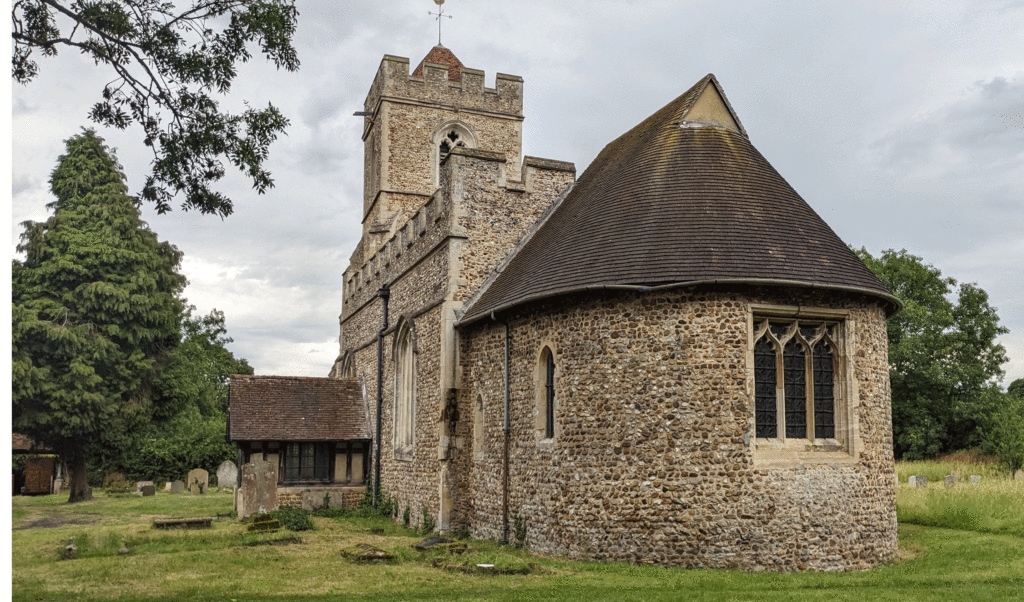
The Church’s door, nave and chancel are Norman it is only one three churches in Hertfordshire with an Apse, a semi-circle wall at the end of the chancel.
It is a gloriously plain and peaceful church, a “thin place”, where it sometimes feels like you can briefly cross over the threshold from this world and into the unseen, real world, which is eternal.
The corbels on the walls holding up the roof arches have carved on them animals, grotesques and people.
Elstow Abbey near Bedford was founded by Judith, a niece of William the Conqueror, who was also the patron controlling the church in Great Wymondley.
Tradition has it that the corbel of the woman with the flat headgear depicts the Abbess of the Abbey, supporting the roof.
Reflection
Great Wymondley once had powerful benefactors, starting with the Abbess at Elstow Abbey. That support ended with the dissolution of the monasteries and patronage transferred to Trinity College, Cambridge.
Today there are no wealthy benefactors to support the building. Instead a tiny faithful band supports this church and raised money for a major renovation of the church, which closed the church building from 2018 to 2022.
Do you regularly think about the charities you could support with your time and money? Do you spend time with a lonely neighbour?
Directions to the site of a Roman Villa
Exit the churchyard through the lychgate and walk along Church Green Lane and turn right onto Arch Road, crossing over to pavement on other side of the road. At the crossroads, cross over Hitchin Road and head straight ahead into Willian Road. Take care when walking because there is no verge. After the cattery and pet crematorium, take the left into a field signposted Hertfordshire Way. Follow the past with line of trees on your left, continue through a row of trees. As you approach a row of trees ahead, you will notice on your right a rough patch of an uncultivated ground. This is the Site of a Roman Villa.
Site of a Roman Villa
Bible Verse
Psalm 103, Verses 8-18
The Lord is full of compassion and mercy,
slow to anger and of great goodness.
As a father is tender towards his children,
so is the Lord tender to those that fear him.
For he knows of what we are made;
he remembers that we are but dust.
Our days are like the grass;
we flourish like a flower of the field;
when the wind goes over it, it is gone
and its place will know it no more.
But the merciful goodness of the Lord endures
for ever and ever toward those that fear him
and his righteousness upon their children’s children.
Background
Based on coins found on the site, a luxurious Roman villa was probably here between 200AD-400AD. It had at least seven rooms, three with heated floors and walls by hypocaust, and mosaic floors with geometric designs. This was the home of a wealthy family, possibly descendants of the pre-Roman British warrior aristocracy, who collected taxes on behalf of the Roman Empire.
Reflection
A high-status Roman Villa, the equivalent of a Georgian Manor House, once stood on this site, but today we can see no visible trace. What has disappeared from your life? A childhood home, a person, a job or your community? Does your life ever feel like it has fallen off the map without a trace? Only God is permanent: he is our past, our present and our eternal future.
Our true home is not a villa, but an eternal room in our Father’s house in heaven. As Jesus said in the Gospel of Mathew, “‘Do not store up for yourselves treasures on earth, where moth and rust consume and where thieves break in and steal; but store up for yourselves treasures in heaven, where neither moth nor rust consumes and where thieves do not break in and steal. For where your treasure is, there your heart will be also.”
Directions to St Ippolyts Church
Turn left onto Gypsy Lane, cross over Hitchin Lane and follow the signpost Public Bridleway 6 Little Wymondley 1 & ¼. Cross under railway line and turn right onto Arch Road. Cross over the roundabout and head along Stevenage Road toward the bus shelter. As you near the bus shelter, take the bridle path into trees. Cross under the A602 and follow the path with trees on the left. Ignore the turning with a small wooden bridge, and continue to walk along the path with the row of trees and Ash Brook on your left, at one point cross a wooden stile. When you come to a collection of gates and a sign that says Private Land No Public Access, turn left across a small wooden bridge and follow a path across a field, heading to the right of the right hand house. Follow the footpath and visit St Ippolyts Church.
St Ippolyts Church
Bible Verse
Isaiah 41:13
For I, the Lord your God,
hold your right hand;
it is I who say to you, ‘Do not fear,
I will help you.’
Background
The church is said to have been built in 1087 under the patronage of Judith, the niece of William the Conqueror. The building was enlarged in the 14th and 15th Centuries.
St Ippolyts Church is named after St Hippolytus, a Roman theologian who died around 236 AD. One of the earliest records of the liturgy, the words used in church services, is attributed to St Hippolytus. It includes the words a Bishop uses when ordaining a priest and it is the earliest record we have of a Eucharistic prayer. Parts of that prayer are still used in Sunday Communion Services.
He is associated with horses because the work “hippos” is the Greek word for horse. There are various legends associated with St Hippolytus which link him to horses.
This in only one of two churches in England named after St Hippolytus and historically horses were brought here to be blessed.
Reflection
On the closest Sunday to St Hippolytus’ feast day, 13 August, people still bring their horses to the church to be blessed.
When the Rev. Ginni Dear arrived as the new vicar in August 2016, she brought with her a deep fear of horses. Although she was scared of horses, she laid her hand on 14 horses and blessed them. Several years later a local riding stable helped her overcome her fears so that she could sit on a horse during the service.
Fear is a common feeling and the Bible promises that God always walks beside us to help us overcome our fears.
Directions to Wymondley Bury and start of walk.
Leave the churchyard though the lychgate, cross over the road and follow the path with the St Ippolyts Village signpost on your right. Continue along Stevenage Road, which eventually turns into a dirt road. Continue past a makeshift red Road Closed sign and turn left onto Sperberry Hill Road, taking care of traffic. Take the first right onto the road signed Preston & Little Aimshoe. When you reach the house The Wye, take the left hand fork.
Go past a weathered sign Private Road to Almshouse. At the green signpost Public Footpath 16 Lower Titmore Green, turn left. Follow yellow signpost Public Footpath 16 diagonally across field. Follow yellow signpost 15. Go through metal kissing gate. Go through another kissing gate and turn right. At the end of the path, turn right through a wooden fence.
Turn right along the road, past the red brick cottages on your left and Lower Titmore Farm. The road turns into a dirt road. As you approach a large tree in a fork of the road, take the left fork onto a path (the wooden signpost is hidden).
Cross the field diagonally, aiming toward a kissing gate in the far corner. Go left through the kissing gate, turn left and follow the path. Carefully cross Stevenage Road to reach the path on the other side and turn left and head into Todd’s Green.
Turn right at green signpost Public Footpath 085. When you read a green signpost pointing two directions, turn left and go through the wooden kissing gate. Turn right with the trees on your right and go through wooden kissing gate in the corner.
Turn right onto Chantry Lane, taking care of traffic and pass under the A602. Carefully cross over the roundabout, taking the left fork and follow the path along the left, keeping to your left, Wymondley Bury, a Manor House dating back to the 14th Century. Follow the path to St Mary’s Church.
St Mary’s Church and Journey’s End
Hopefully you will return home with a sense of renewal.
We end with a stanza from the pome “Somewhere” by the poet and priest R.S. Thomas
Somewhere
Something to bring back to show
you have been there: a lock of God’s
hair, stolen from him while he was
asleep; a photograph of the garden
of the spirit. As has been said,
the point of travelling is not
to arrive, but to return home
laden with pollen you shall work up
into the honey the mind feeds on.
Sources:
The Wymondleys, Noel Farris
The Yeomen of Ippolyts: A Country Parish before 1800, Daphne France
St Ippolyts: A Country Parish in the Nineteen Century, Daphne Rance
The Archaeology of the Wymondley, Keith Fitzpatrick-Matthews,
Archaeology Officer at North Hertfordshire District Council
The Buildings of England: Hertfordshire, Nikolaus Pevsner & James Bettley
A Dictionary of Architecture and Landscape Architecture, J Harvey,
Oxford Dictionary of National Biography