
New Earth; New Heaven
From industrial wasteland to a resurrected landscape
God’s recreation of the new day
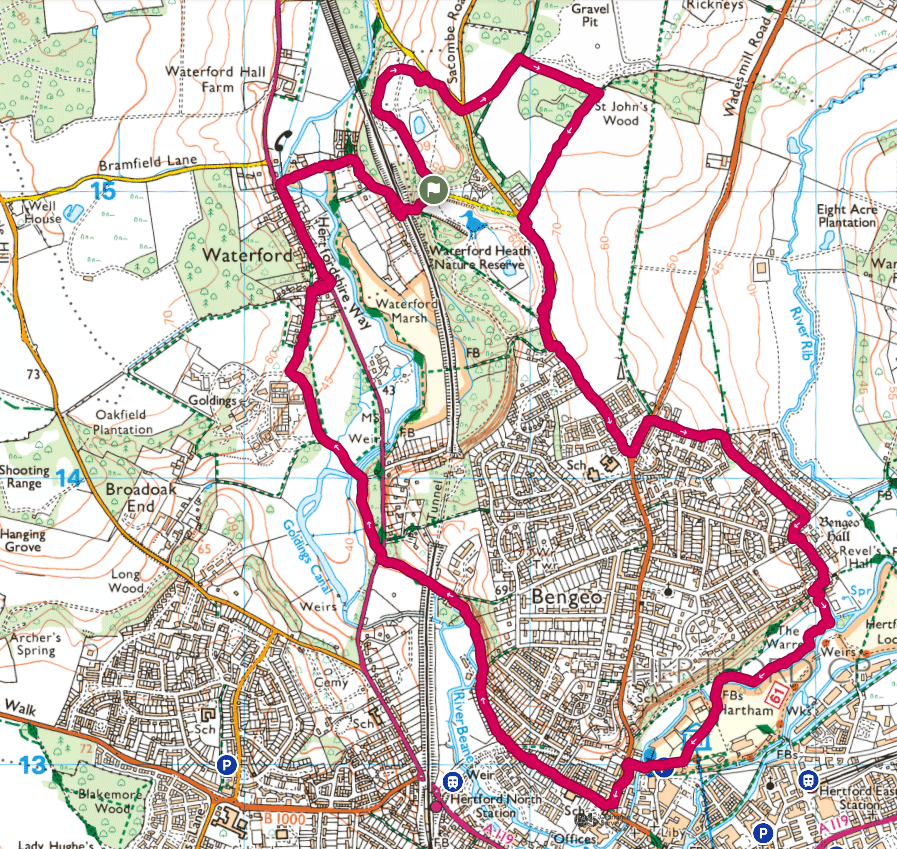
Download this Map as a PDF file
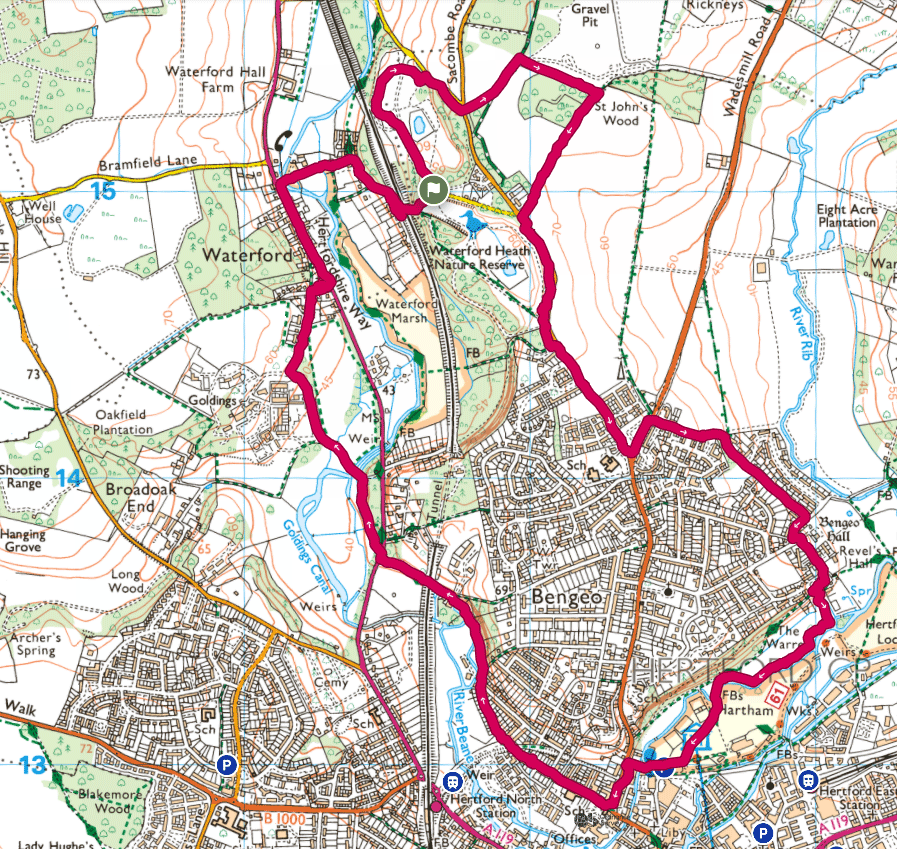
Download combined path and map to print as a booklet
Bengeo, Hertford & Waterford – 6 mile circular walk
This pilgrimage invites us to notice God’s renewing work in the world around us, from the landscape to the beauty of art, music and sacred spaces. As we journey, we are encouraged to reflect on our own part in God’s recreation of the new day and the promise of a new earth and a new heaven.
Revd. Emma-Jane Wilkinson, Vicar, King Charles the Martyr, Pottes Bar
Bengeo Waterford walk directions
The pilgrimage begins at the Waterford Heath Nature Reserve car park, SG14 3LU.
Turn left out of the car park through the wooden kissing gate. Walk straight ahead along the old concrete quarry road towards the concrete and iron sculpture at the top of the hill.
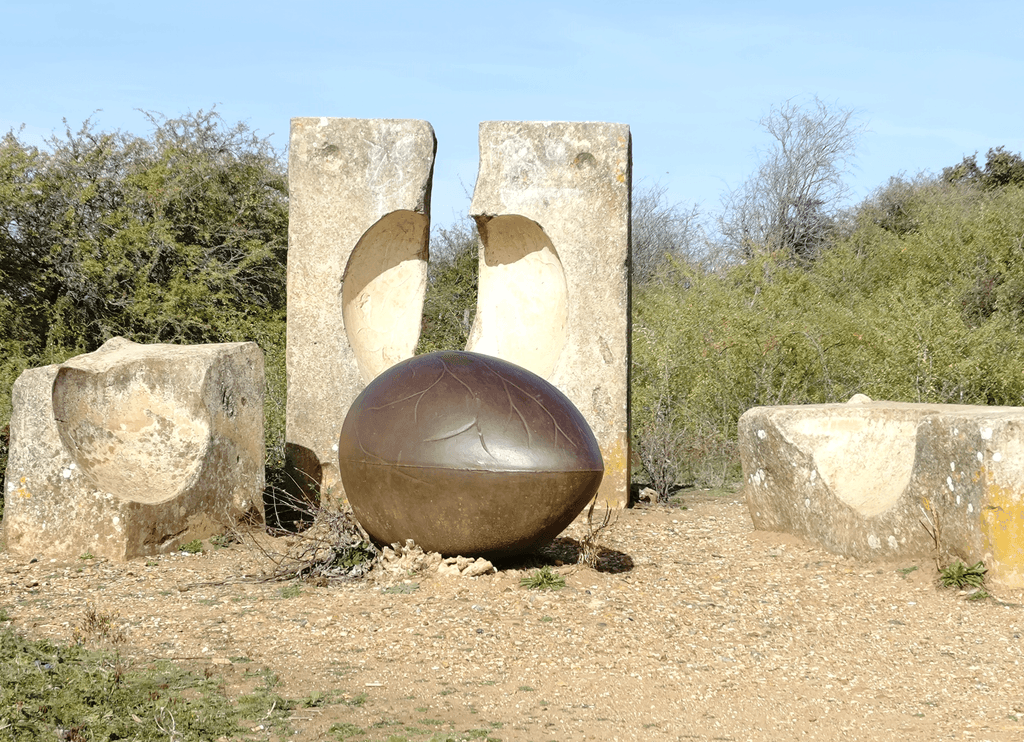
We begin our pilgrimage beside a sculpture called ‘Breaking the Mould’ created by Andrew McKeown in 2000 and is one of 21 copies of this sculpture throughout the UK. In the sculpture, a giant iron seed emerges from an old, broken industrial mould showing that what was once a symbol of industry and production has become a place from which new life can emerge.
The land around us has its own story. Once derelict and shaped by industry, it has been transformed into parks and open spaces, showing that what appears to have reached the end of its useful life, has been given a new purpose.
Reflection
“If anyone is in Christ, there is a new creation: everything old has passed away; see, everything has become new!” 2 Corinthians 5:17
The Bible speaks of God as the one who makes all things new. But God’s new creation is not necessarily about throwing everything away and starting again. Sometimes it is about taking what is broken, wounded or forgotten and bringing new life from it.
Perhaps there are parts of our own lives that we regard as past their usefulness: things we regret, dreams that have faded, relationships that have been damaged and yet God is not finished with us.
The seed reminds us that new life can be growing even when we cannot yet see it.
Pause and Pray
God of new beginnings, bring life from what is broken, hope from what is forgotten, and new possibilities from what seems to have reached its end. Help us to trust your work of renewal. Amen.
A question to carry with us as we journey on
What in my life, in my community or in the world around me, might God be seeking to renew?
Take the narrow path ahead through the thicket. When you emerge from the
thicket walk straight ahead across concrete quarry road and follow path that
bends to the right, passing simple wooden bench.
Turn L at the new planting sign and go up steps next to wooden handrail.
Ignore path to the right and go take path straight ahead which will bend to the
right, keeping wire fence on left.
Take the first path on the left through the wooden kissing gate and cross over Sacombe Road and take path straight ahead. (Public Bridleway 7 Chapmore End 1 mile)
At the intersection of paths, continue straight veering to the left.
Where paths meet at three 6/7 bar gates, take the path to the right.
But before you do, pause and reflect
Reflection
“Do not remember the former things, or consider the things of old. I am about to do a new thing; now it springs forth, do you not perceive it?” Isaiah 43:18–19
We are standing here beside three gates. A gate is an ordinary thing, but it can also be a powerful symbol as it marks a boundary between one place and another. When we pass through a gate, we leave something behind and enter somewhere new so perhaps that is why gates feature so often in the Bible. They can speak of welcome, of opportunity, of protection, and of new beginnings. Jesus himself says, “I am the gate” — the one through whom we find life and the courage to step into something new.
As you look at the gates, think about the thresholds in your life. Are there things you need to leave behind or a new beginning that God might be inviting you to step into? Or perhaps you simply need the courage to take the next step, trusting that God is already at work, making all things new.
God’s new day does not always arrive with a dramatic announcement. Sometimes it comes quietly, almost unnoticed. Sometimes it is simply a gate opening onto a path we have never walked before.
As you continue on the walk:
Why not walk for a few moments in silence looking for one small sign of life or beauty that you might otherwise have overlooked maybe a leaf, a bird, a flower, the movement of the clouds or the sound of the wind in the trees.
At the junction with the post and the field ahead, turn right on the footpath through the woods.
Near the end of the path you will pass by wooden fence panels of several houses.
Turn L onto Sacombe Road, walk about 30 steps and turn right onto path into woods, just after the SLOW sign painted on the road, through metal gate and turn L and follow path.
Here there is a bench where you could pause, and look out across the Beane Valley and the distant Bramfield Woods which can be seen beyond the Waterford Heath.
Reflection
“You care for the land and water it; you enrich it abundantly… The grasslands of the wilderness overflow; the hills are clothed with gladness.” Psalm 65:9–13
The psalmist speaks of a God who cares for the land, who waters it, enriches it and makes it fruitful. There is a wonderful sense of abundance in these words. The earth is not simply surviving; it is overflowing with life.
And as we look out across this landscape, we can see something of that abundance for ourselves. It is easy to forget that this view will not always have looked like this as this was once a working quarry, a place where the earth was dug up and taken away. But when that work stopped, something remarkable began to happen as creation started to reclaim the space.
The psalmist reminds us that this is not something we should take for granted because behind the beauty we see is the sustaining generosity of God, who gives life to the earth and enables it to flourish.
Here we are invited to slow down and pay attention. To notice that creation is alive, precious and held within God’s loving care.
And perhaps there is something here that speaks to our own lives.
There are times when we might feel that parts of us have become desolate and we wonder whether anything new can grow. Yet the God who brings abundance to the land is also the God who patiently nurtures new life in us. This quarry reminds us that renewal can take time. It may begin quietly, almost unnoticed, before gradually becoming something beautiful.
So, as we sit here, let us give thanks for the life that surrounds us. Let us ask God to open our eyes to the abundance of creation, to help us care for the earth entrusted to us, and to make room for new life to flourish in our own hearts.
Pause and pray
God of the earth, you water and enrich your creation and fill it with life. Open our eyes to the beauty and abundance around us. Teach us to care for your world and to trust in your renewing love. Amen.
Follow path between two wooden posts and through two more wooden posts.
Take the left hand fork into the woods
Exit through wooden kissing gate and turn left to the road and then right onto Sacombe Road.
Follow Sacombe Road through residential area and at the roundabout turn left on to Wadesmill Road.
Turn Right on Watermill Lane North and follow it until it dead ends and follow the sign Public Bridleway 14, just past Temple Fields on the right.
Take path through the woods to Watermill Lane
Walk past the houses and then turn right on to Ware Park Road
At the red brick wall of Bengeo Hall, turn Left onto St Leonards Road to St Leonard’s Church Bengeo.
Enter the Church yard.
St Leonard’s Church is a 12th century Norman building and the oldest building in Hertford. It was the parish church of Bengeo until 1855 when it was succeeded by the new Holy Trinity parish church designed by Benjamin Ferrey. It is one of only three churches in Hertfordshire with an apse, where the chancel ends with a semi-circle. The other two being Great Wymondly and Great Amwell.
St Leonard’s Church, despite being closed for regular services, is still used in the Summer months for services, cream teas, exhibitions and concerts.
There is a bench in the church yard where you may like to sit for a moment and reflect.
Reflection
“Do you not know that you are God’s temple and that God’s Spirit dwells in you?” 1 Corinthians 3:16
Although this church is no longer in regular use, it still holds the prayers, memories and stories of those who have gone before us and of the faith that shaped their lives. We know that God cannot be confined to buildings because his dwelling place is among his people and we, together, are the temple of the Holy Spirit.
The building may fall silent, but that does not mean that God has abandoned the people who once worshipped there, or that the prayers offered within its walls have been forgotten. And so perhaps this building helps us to consider if we can allow God to renew us rather than simply trying to preserve what has always been because the God of the new day is not only the God of what has been he is also the God of what might yet be.
Pause and pray
God of the living and the departed, we give thanks for those who have worshipped here and for all the prayers that have risen from this place. Renew your Church in every generation, and make our lives a dwelling place for your Spirit. Amen.
A question to carry as we journey on
What does it mean for me to be a living temple of God’s Spirit? And where might God be inviting renewal in the life of the Church?
At the far end of the churchyard, go through metal kissing gates into Hartham Common. Follow the path down stairs next to wooden handrail and the edge of the common with small marshes,
When you reach a tarmac path turn left and continue on tarmac path, keeping the river on your left, and when you reach the park, cross the wooden bridge and then, keeping the tennis courts on your right, head towards the building with the turret..
Turn right at the carpark and follow tarmac path on the right through it and cross car/pedestrian bridge.
Turn left onto Port Hill.
Go over the bridge and when you see the fish and chip shop ‘Oh My Cod’ in front of you, cross the road taking care of the traffic.
Then turn right into Port Vale. Look out for the creativity on the left hand side of the road at Courtyard Arts.
Pause and reflect
Reflection
“O Lord, how manifold are your works! In wisdom you have made them all; the earth is full of your creatures.” Psalm 104:24
When we are walking we often come across something that we don’t expect to see, in this case, trees wrapped in colourful woollen scarves and a wall transformed by a mural depicting Van Gogh in a garden, surrounded by sunflowers, flowers, vegetables, a gardener and a church.
These are all expressions of creativity, imagination and human hands at work.
The psalmist looked at the world around him and cried out in wonder: “How manifold are your works!” because the earth is full of God’s creativity. From the smallest flower to the greatest tree, from the changing seasons to the variety of human life, creation reveals a God whose imagination seems to have no limits.
And we, made in the image of that creative God, are invited to share in that creativity.
Creativity is not reserved for artists. It might be found in the person who plants a garden, cooks a meal, writes a poem, makes something with their hands, or finds a new way to care for a neighbour.
God’s work of recreation is not simply something we observe. We are invited to participate in it.
Take a few moments to look carefully at these works of art. Notice the colours, the patterns, the details and give thanks for the imagination and effort of those who created them. Then ask yourself:
What gifts has God given me, and how might I use them to bring a little more beauty, joy or life into the world?
What small act of creativity, kindness or care could I offer today as part of God’s work of making all things new?
Pause and pray
Creator God, you have filled your world with beauty, colour and wonder. Thank you for the gifts of imagination and creativity and for all those who use them to bring joy to others. Open our eyes to beauty in unexpected places. Help us to recognise the gifts you have given us and to use them in the service of your world. May our lives, like these works of art, bring colour, hope and new life to the places in which we live. Amen
Before you leave, read the information about Van Gogh’s 100 mile walk to visit his sister in Welwyn in 1876. It is imagined that he may have walked here in Hertford, and as you continue on the walk, you may like to reflect on the words that he wrote to his brother Theo June 13, 1873:
‘The countryside here is magnificent, completely different from Holland or Belgium. Everywhere one sees splendid parks with tall trees and shrubs, where one is allowed to walk.’
Continue on Port Vale. Cross over Melson Street and follow Port Vale until it turns into Molewood Road. Walk past the Mill Stream pub, where you may like to stop for refreshment and toilets, and then continue along the road until it eventually turns into a public footpath (number 95 Little Mole Wood) onto a private road. This is just after Wellington Street.
At the red brick bridge, turn L onto the public footpath (Hertfordshire Way)
Turn R on North Road and as soon as you cross the bridge, cross over the road and take the path, the River Beane (or its dry bed) on your left.
Pause and Reflect
“The Lord is my shepherd; I shall not be in want. He makes me lie down in green pastures and leads me beside still waters.” Psalm 23:1–2
As we look out across the river, with the sheep grazing quietly in the distance, there is something wonderfully peaceful about this scene.
The water moving gently along its course. The sheep scattered across the fields. The trees and grasses growing around us. Nothing seems to be in a hurry.
And yet, even in this peaceful landscape, life is being sustained. The river provides water. The grass provides food. The land provides a place for the sheep to rest and graze.
The psalm reminds us that God does not simply create the world and then leave it to fend for itself. God is intimately involved in the life of creation, sustaining and caring for all that He has made.
In the busyness of our lives, here beside the river we are invited to pause and remember that we are part of God’s creation.
As you look at this tranquil scene, consider
What would it mean to trust God enough to stop striving for a moment?
To allow ourselves to be led beside still waters?
To recognise that we are loved, held, and part of God’s good creation?
As you look across the river, give thanks for the water that sustains life, for the land that provides, and for the creatures who share this world with us.
Pause and pray
God our shepherd, you lead us beside still waters and provide for all your creatures. Help us to rest in your love, to trust your care, and to become faithful stewards of the world you have entrusted to us. Amen.
Turn L on road, crossing a long bridge.
Take the right hand fork in the Road.
Turn Right on Goldings Lane and using the footpath at the side of the metal gates, head to the Church.
When you arrive at the church, pause before opening the door and then slowly open the door and gaze at the window which is directly in front of you.
This window, designed by Harry Clarke and made by Karl Parsons in 1929 tells the story of Saint Cecilia who is said to have heard heavenly music inside her heart when she was forced to marry the pagan, Valerian. She is the patron saint of music, especially church music, and, because her name means blind, she is also the patron saint of the blind. Notice that above her an angel leans towards her, as though whispering something in her ear and that at the bottom of the window are the words, ‘the first fruits unto God.’
Reflection
“Make a joyful noise to the Lord, all the earth; break forth into joyous song and sing praises.” Psalm 98:4–6
As we have journeyed to this point we have been thinking about God’s work of recreation, thinking about how new life emerges from what was broken, beauty appearing in unexpected places, and the creativity that God shares with his people.
Now, as we arrive at this window, we are reminded that creation is not simply something we see. It is also something we hear.
The psalmist calls upon the whole earth to sing praises to God. The sea, the rivers, the hills and the trees are all invited to join in the song.
Of course, the earth does not sing as we do. But if we stop and listen, we might hear something of that song: birdsong in the trees, the sound of water, the wind moving through the leaves, or the laughter of a child.
And then there is human music: the songs we sing in church, the music that lifts our spirits, the melodies that bring back memories, and the quiet hymns that give us words when we cannot find our own.
Saint Cecilia reminds us that music can be an offering to God. But perhaps this window also invites us to think about the unique gifts that each of us has to offer. Not everyone can sing or play an instrument. Yet each of us has something we can offer God: a kind word, a helping hand, a prayer, a creative gift, or simply our willingness to be present for someone who needs us.
At the foot of the window are the words “The first fruits unto God.” The first fruits were the earliest and best of the harvest, offered in thanksgiving to God.
A time of contemplation
As you look at the window, listen quietly to the sounds around you, or perhaps play one of your favourite pieces of music on your phone. Then reflect:
What gift, however small, could I offer to God today?
How might my life become part of the song of God’s new creation?
Pause and pray
Creator God, whose voice called the world into being, we thank you for the gift of music and for the many ways in which your creation sings your praise. We thank you for Saint Cecilia and for all those who use their gifts to glorify you. Help us to recognise the gifts you have given us and to offer them generously in your service. May our lives become a song of thanksgiving, bringing hope, beauty and joy to your world. Amen.
Once you have finished looking and reflecting on this window, turn and take in the beauty of church, a place filled with extraordinary colour and light. You may like to turn the lights on – one switch is to the left of the main door and another by the side of the organ.
St Michael and All Angels Church, was built in 1871–72 by architect Henry Woodyer and is a Grade II* listed building. Its interior is particularly notable for its stained glass, mosaics and richly patterned decoration. The stained glass spans several decades, from the church’s construction through to the early twentieth century and is a remarkable collection of work associated with the Pre-Raphaelite movement, including artists such as Edward Burne-Jones, William Morris and Ford Madox Brown. Later windows include work by Douglas Strachan, Selwyn Image and Karl Parsons
The windows are filled with angels, saints, biblical stories, flowers and foliage, with the natural world being woven into the very fabric of the building as the windows tell the Christian story of creation, incarnation, redemption and resurrection. This makes the church a fitting destination for our pilgrimage when we are thinking about God’s recreation of the new day because the same God who creates plants, flowers and trees is celebrated through the work of artists, designers and craftspeople.
Windows to particularly look out for are: the Nativity and musical angels, the Annunciation, Miriam, St Michael, Noah and St Philip, The Road to Emmaus,
Spend a few moments looking at the windows.
• What do you notice about the way the natural world is represented?
• Where do you see signs of God’s beauty and creativity?
• Which window particularly catches your eye?
Notice also the mosaic around the chancel. These were created by Powell and Sons of Whitefriars between 1901 and 1912. Notice the angels, the rich colours and the flowing patterns of leaves and vines. There is something almost garden-like about the way the decoration fills the walls, bringing together the beauty of the natural world and the glory of heaven.
Reflection
At the beginning of our pilgrimage, we stood beside a seed emerging from a broken mould, and we thought about new life emerging from what was once derelict.
We have since seen how creation can break through and reclaim places that have been changed by human hands. We have walked through landscapes where grasses, trees and wildflowers have found space to flourish, and we have paused beside the river. Now we have arrived at a place where the beauty of creation has been captured in glass and transformed by light.
Look at the windows around us, with their rich colours and images of the natural world. The light shining through them is a beautiful reminder of the light of Christ, which St John tells us shines into the darkness and cannot be overcome.
And look, too, at the mosaics. Small pieces of coloured material have been brought together by human hands to create something beautiful. The angels, the flowing patterns and the images of vegetation remind us that the beauty of creation and the worship of God belong together.
A single piece of glass or a fragment of mosaic might seem insignificant on its own. But brought together, each piece has its place within a greater design.
And perhaps that is true of creation itself.
The world is made up of countless individual things: a blade of grass, a tiny insect, a tree, a river, a human life. Each has its own place within the extraordinary richness of God’s creation.
And perhaps we can see ourselves in these windows and mosaics, too.
Like the many pieces brought together to make a single image, each of us has a place within God’s great story. Each of us has something to offer and each of us can reflect something of God’s beauty and love.
As we look at these windows and mosaics, we remember that God’s creation is not simply something to admire, but something of which we are a part, something we are called to cherish, and something that God is continually renewing.
When we look at the beauty around us, we catch glimpses of what the world can be. But the Christian hope is that God is not simply preserving the world as it is. God is bringing about a new creation.
When you are ready, join together in this short act of worship
Let us pray.
Creator God, open our eyes to your beauty, our ears to your voice, and our hearts to your presence. As we pause in this beautiful place, help us to see the world afresh and to recognise your light shining among us. Amen.
Bible reading
Revelation 21:1–5
Then I saw a new heaven and a new earth; for the first heaven and the first earth had passed away, and the sea was no more. And I saw the holy city, the new Jerusalem, coming down out of heaven from God, prepared as a bride adorned for her husband.
And I heard a loud voice from the throne saying,
“See, the home of God is among mortals. He will dwell with them; they will be his peoples, and God himself will be with them; he will wipe every tear from their eyes. Death will be no more; mourning and crying and pain will be no more, for the first things have passed away.”
And the one who was seated on the throne said, “See, I am making all things new.”
In this place today, we have glimpsed something of the beauty of the new world that God has promised: a world where God dwells with his people, where tears are wiped away, and where the whole of creation is restored.
But until that day, we are invited to become part of God’s work of renewal.
When we leave this church, we will return to our ordinary lives and encounter the same world, with its struggles, its brokenness and its beauty. But perhaps we will see it differently as a result of today.
Perhaps we will be more aware of where new life is emerging. Perhaps we will recognise the creativity and gifts of those around us more readily. Perhaps we will discover new ways in which we can bring colour, hope and love into the lives of others. So that, in some small way, the light of Christ can shine through us, just as sunlight shines through these windows and brings the colours of the mosaics to life.”
We began our pilgrimage with a seed breaking through a mould and we end with a promise:
“See, I am making all things new.”
Because God’s recreation of the new day is not finished and we are invited to share in it.
Our response
Think of one thing that has spoken to you during this pilgrimage. It might be a seed, a gate, a tree, a mural, a person, a moment of silence, a river or something you have noticed along the way.
Now bring to mind one place in your life or in the world where you long to see God’s renewing work.
What might you offer to God as part of that work?
Spend a few moments in silence.
A responsive prayer
God of creation, you make all things new.
Open our eyes to the beauty of your world.
Christ, light of the world, shine into our darkness.
Help us to reflect your light in all that we do.
Holy Spirit, giver of every good gift, renew your Church and your people.
Make us generous in offering our gifts to your service.
God of hope, send us out to share in your work of renewal.
May we carry your light and share in your work of making all things new.
In the name of Jesus, the light of the world.
Amen.
After you have visited the church, exit through lychgate and turn left onto the High Road
Walk on the path on the Right Hand side
Turn right onto Vicarage Lane and follow it back to the Car Park
We have come to the end of our pilgrimage, and we have returned to the place where we began. When we set out, we stood beside a seed emerging from a broken mould. We have walked through a landscape renewed, passed through gates, paused beside a church whose worship has fallen silent, and discovered creativity, beauty and light along the way. We have ended at St Michael and All Angels, surrounded by windows and mosaics that tell stories of God’s creation, his people and his love revealed in Jesus Christ. Now we stand once again in this car park, ready to return to our everyday lives.
But perhaps we do not return quite as we came. For a pilgrimage is not simply about the places we visit – it is about allowing God to change the way we see the world, and discovering how we might share in his work of renewal.
Reflection
“I am about to do a new thing; now it springs forth, do you not perceive it?” Isaiah 43:19
As we return to where we began, think back over the journey.
Perhaps you noticed something beautiful that you would normally have walked past. Perhaps a gate made you think about a new beginning, or the old church prompted you to reflect on your own faith. Perhaps you were moved by the beauty within the church, or simply enjoyed the gift of walking together.
Whatever has stayed with you, give thanks for it.
God’s work of recreation is not confined to the places we have visited today. It continues in our homes, our communities, our churches and the wider world.
And so the question we take away today is
“What might God be inviting me to do, or to see differently, as I return to my everyday life?”
A final prayer of thanksgiving
You may wish to pray together:
For the beauty of the world around us, and for the gift of this day,
We give you thanks, O God.
For new life emerging from brokenness, and for the hope of renewal,
We give you thanks, O God.
For the creativity, gifts and kindness of those who make our world more beautiful,
We give you thanks, O God.
For the saints and faithful people who have gone before us, and for the stories held in the churches we have visited,
We give you thanks, O God.
For the light of Christ, which shines in the darkness and cannot be overcome,
We give you thanks, O God.
For the work of renewal to which you call us,
Make us willing and faithful, O God.
Amen
Alternatively, you may wish to pray this prayer individually:
God of creation and new creation, thank you for walking with me today.
As I return to my home and my everyday life, keep alive in me the wonder I have discovered, the beauty I have seen and the hope we have shared. Open my eyes to the new things you are doing and give me courage to be part of your work of renewal.
Help me to bring colour, kindness and hope into the places where you have planted me. May I never forget that your work of recreation is not finished, and that you invite me to share in it. Amen.